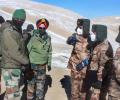
'China and India have encountered some setbacks in recent years which do not serve the fundamental interests of the two countries and the two peoples'
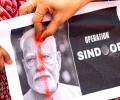
World leaders, including the UN Secretary-General and US President Donald Trump, have urged India and Pakistan to exercise restraint and seek peaceful solutions to the ongoing tensions. The calls for calm come after India conducted airstrikes in Pakistan-occupied Kashmir in response to a recent terrorist attack. Leaders from the US, Russia, UK, China, UAE, Qatar, and Japan have expressed concern over the escalating situation and emphasized the need for dialogue and de-escalation.

Leader of Opposition in the Lok Sabha Rahul Gandhi on Monday said the address of the President to the two Houses was similar to the one made last year, and claimed that it was the same 'laundry list' of things the government has done.
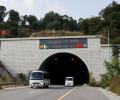
At least five Chinese nationals were among the six persons killed on Tuesday when an explosive-packed vehicle rammed into their bus in Pakistan's troubled northwestern province of Khyber-Pakhtunkhwa, officials said.

It is the first highest level face-to-face meeting between the two sides after the border row escalated in eastern Ladakh in early May.
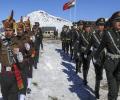
India on Monday announced it has reached an agreement with China on patrolling along the Line of Actual Control (LAC) in eastern Ladakh, in a major breakthrough in ending the over four-year-long military standoff ahead of a likely meeting between Prime Minister Narendra Modi and Chinese President Xi Jinping in Russia this week.

Dr Kissinger, then US president Richard M Nixon's national security adviser, feigned illness on a visit to Pakistan in July 1971 and made a secret trip to Peking, as Beijing was then called, to begin the process of a rapprochement between America and China. It was a debt that Chinese leaders have never forgotten.

Congress leader Rahul Gandhi has said the 'wholesale attack on the democratic system' currently underway in India is the single biggest risk the country is facing, and asserted that allowing different traditions to thrive is very important as 'we cannot do what China does, which is to run an authoritarian system'. IMAGE: Kindly note that this image has been posted for representational purposes only. Photograph: / Rediff.com Speaking at a seminar titled 'The Future is Today' at the EIA University in Medellin, Colombia, Gandhi also alleged that there are 'huge amounts of corruption at a centralised level' in India now. "In India, we have huge amounts of corruption now at a very centralised level. So, three or four businesses taking over the whole economy, having a direct relationship with the prime minister, is rampant in India," the Leader of Opposition in Lok Sabha said. "But I believe decentralising power, making things more transparent, bringing people into conversations, and bringing people into processes is the best way forward," Gandhi said while addressing the seminar on Wednesday. Hitting back at the Congress leader for his remarks, the Bharatiya Janata Party on Thursday accused Gandhi of insulting and degrading India on foreign soil. Posting a video clip of Gandhi's speech on X, BJP national spokesperson Gaurav Bhatia said, 'Rahul Gandhi does it again, degrades India on foreign soil. From defaming our democracy in London, to mocking our institutions in the US, now in Colombia he spares no chance to insult Bharat globally.' 'This isn't dissent. It's disgrace to the fake Gandhi. Criticising BJP may be your right but dare you malign Mother India for your cheap and petty politics,' Bhatia said. Speaking at the seminar, Gandhi said India has a much more complex system as compared to China and its strengths are very different from that of the neighbouring country. India also has a very old spiritual tradition and a thought system with profound ideas that are useful in today's world, he said, adding that there is a lot that the country can offer in terms of tradition and way of thinking. "I am very optimistic about India, but at the same time, there are fault lines within the Indian structure. There are risks that India has to overcome. The single-biggest risk is the attack on democracy that is taking place in India," the Leader of Opposition said. "India has multiple religions, traditions and languages. India is actually a conversation between all its people. Different ideas, religions and traditions require space. The best method for creating that space is the democratic system," he said. "Currently, there is a wholesale attack on the democratic system in India, so that is a risk. The other big risk is different conceptions -- some 16-17 different languages, different religions... So, allowing these different traditions to thrive, and giving them space to express themselves is very important for a country like India.

'While the President has been critical of India, he has gone out of his way to compliment PM Modi. They have an incredible relationship.'
'The two sides should support rather than undermine each other, strengthen cooperation rather than guard against each other, and enhance mutual trust rather than be suspicious of each other'

We should reassess what India's role in the world is and whether we are doing the right thing for ourselves, notes Aakar Patel.
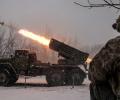
A peace keeping role for India is a distinct possibility. Indian military has both the numbers and experience to carry out this job, observes Colonel Anil A Athale (Retd).
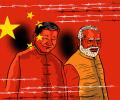
The bilateral trade between India and China has been growing at a healthy rate, but the trade gap remains sharply tilted in Beijing's favour. India has time and again flagged its concern over the ballooning trade deficit and the non-trade barriers faced by Indian goods in the Chinese market.

Japan is expected to increase its investment target in India from the earlier 5 trillion yen ($34 billion) to almost 10 trillion yen.
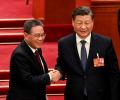
'The real issue between India and China is that the Chinese have transgressed along the Line of Actual Control at multiple points.'

The visit comes two days after Pakistan officials shared with the Chinese embassy the preliminary findings of their investigation into the attack.

Prime Minister Narendra Modi and Chinese President Xi Jinping are expected to hold bilateral meetings on the sidelines of the SCO summit in Tianjin, as both nations look to strengthen ties amid global trade tensions.

The External Affairs Ministry claimed that more than mere courtesies were exchanged between Prime Minister Narendra Modi and China President Xi Jinping at Bali G20 Meet in November 2022.

Rahul Gandhi accuses PM Modi of prioritizing his image over national security after the Pahalgam attack, challenging him to refute Trump's claims of brokering a ceasefire between India and Pakistan.
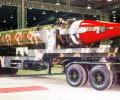
The US intelligence assessment highlights Pakistan's near-certain procurement of weapons of mass destruction-applicable goods from foreign suppliers, primarily through Chinese support.

Foreign Secretary S Jaishankar said bilateral ties with China faced 'some challenges' in the recent past.

China on Tuesday confirmed that it has reached an agreement with India to end the standoff between the two armies in eastern Ladakh.

'Modi's a great leader... But I don't understand why he's getting into bed with Putin and Xi Jinping...'

Last year, China held a meeting with some South Asian countries on COVID-19 vaccine cooperation without the participation of India.

Jaishankar also said that there is a need to take the disengagement process forward.
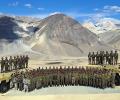
If China is accommodating regarding Depsang and Demchok, a resolution of the Sino-India territorial dispute in Eastern Ladakh could be possible.
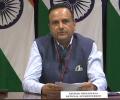
Ministry of External Affairs (MEA) Spokesperson Anurag Srivastava said Indian bulk cargo vessel MV Jag Anand has been on anchorage near Jingtang port in Hebei province of China since June 13 and it has 23 Indian sailors.
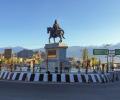
Terming the charge that Wangchuk incited the violence in Leh as 'misplaced', she claimed that he has been protesting in the "most Gandhian way possible" and the "situation escalated" on September 24 due to the actions of the CRPF.

Both sides have completed creation of a buffer zone of three kilometres in the three friction points of Galwan Valley, Gogra and Hot Springs as part of a temporary measure aimed at reducing the possibility of any confrontation.
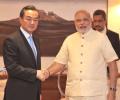
Special Envoy of the Chinese President and Foreign Minister Wang Yi on Monday called on Prime Minister Narendra Modi and conveyed his government's keenness to engage with the new Indian dispensation to strengthen cooperation in key areas.
"The meeting thus did not result in resolution of the remaining areas," the Army said in a statement.
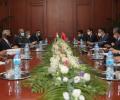
In a meeting on the sidelines of the summit of the Shanghai Cooperation Organisation (SCO) in Dushanbe on Thursday, the two foreign ministers exchanged views on the current situation in the region and agreed that military and diplomatic officials of both sides should meet again and discuss resolving the remaining issues at the earliest.

It is time the political leaderships in this country arrived at a common ground over issues of foreign and security policy concerns. There has to be a greater communication between the government and the Opposition leaderships for the nation to present a unified face against the rest of the world, advises N Sathiya Moorthy.
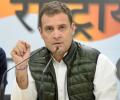
He highlighted how the ministry of foreign affairs of People's Republic of China in its statement made a mention of the Galwan Valley, but the Indian external affairs ministry did not do so.
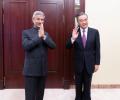
'It is advisable for Indian interlocutors to follow the Chinese tactic of repeating the Indian position, both for the record and to test the Chinese negotiator's resolve and intentions.' A riveting excerpt from former foreign secretary Vijay Gokhale's The Long Game: How the Chinese Negotiate With India.
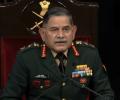
Army Chief General Upendra Dwivedi Monday said there is still a 'degree' of standoff between the Indian and Chinese militaries along the Line of Actual Control in eastern Ladakh and both sides need to sit down and firm up a broader understanding on how to calm down the situation.
India is not "rethinking" supporting investments from China, said Commerce and Industry Minister Piyush Goyal on Tuesday, referring to a proposal made in the Economic Survey 2024. The survey by India's chief economic advisor last week said India had two "choices" to benefit from the so-called China plus one strategy, either by integrating into that country's supply chain or by promoting foreign direct investment (FDI). "Chief economic advisor's report speaks about new ideas and gives out their own thinking. It is not at all binding on the government and there is no rethinking to support Chinese investments in the country," Goyal told reporters in Delhi.
Foreign policy expert C Raja Mohan has said that the recent disengagement of troops with China in eastern Ladakh has given a small opening to India, but the "big issues" remain. He also stressed the importance of strengthening India's ties with the US for technological and economic growth.

Khan's visit evoked considerable interest in Beijing as it comes in the wake of his past criticism of the USD 50 billion China-Pakistan Economic Corridor projects and remarks by his ministers to cut down some of the projects over debt concern.
India has lodged a "solemn protest" with China over the establishment of two new counties in the Hotan prefecture, as parts of these regions fall within India's union territory of Ladakh. The Indian government asserted that the creation of these counties will not impact its sovereignty over the area and does not lend legitimacy to China's "illegal and forcible" occupation.
